
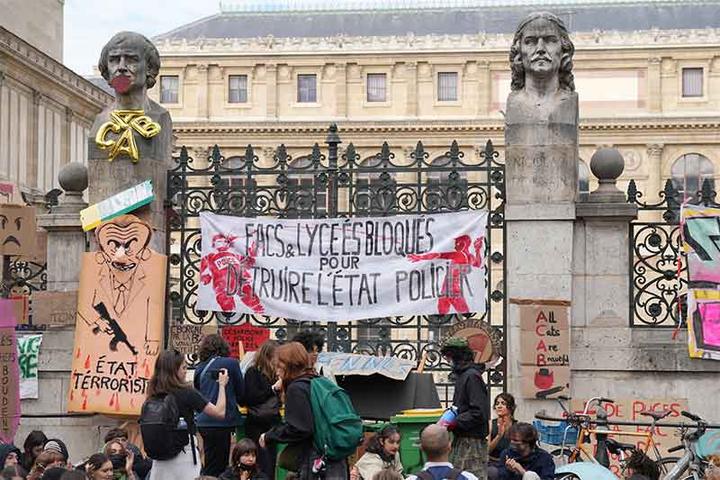
The following remarks, forged in the heat of battle during a wave of student unrest that is now spreading to Belgium and Italy, were posted to x.com on October 6, 2026. For a longer position piece by the same authors, see their recent article, "Will 1793 Take Place?"
Other languages: Français, Deutsch
The student revolt is the spearhead of the movement announced for October 17.
The “gangs” [bandes] of students from working-class neighborhoods constitute the actual driving force both within and against the current youth movement. In a sense, this force is less a part of the student movement than it is a continuation of the Nahel revolt. It has neither demands nor representatives; it does not conform to the codes of the Left and rejects bourgeois politeness. It wants revenge.
The universities have followed the high schools and joined the dynamic of the blockades. They, in turn, could bring about a qualitative leap by, for example, launching an occupation that could be taken up and spread by other sectors of society—whether students or not. This hypothesis, however, is oppposed by the overwhelming dominance of student union organizations, which leave little room for group spontaneity, collective ingenuity, and self-subversive practices.
The unions cannot come to terms with the idea of October 17, as it reminds them too much of the Yellow Vests. They must pretend to join the movement in order to gain better control over it—both through their monopoly on negotiations and by dictating the timeline. If the inter-union coalition called for action on October 6 alongside the students, it was only to better defuse the call for October 17, which they wish to reduce to an interim date ahead of their mobilization on November 5.
In high schools, the left differs from other political forces in form, but not in substance. In form, the left pushes students into the role of victims, thereby allowing itself to present as the “responsible adults.” Consider the human chains of parents and teachers, or elected officials denouncing the police’s use of LBD weapons. It is striking, however, that batons, shields, helmets, and other standard components of the arsenal of democracy are far less frequently called into question.
Unlike the left, we have neither flags to wave, nor a tempo to set, nor lessons to teach.
How should we deal with the enthusiasm for “October 17” and the way certain segments of the youth present it as an echo of the Yellow Vests movement? Even if a new generation seems to invoke its symbolic power full of hope, it is by no means certain that reusing the object will help us rediscover its spirit. Nevertheless, perhaps that is precisely what is expected of us: to don it and see if it—even if only temporarily—embodies a sense of belonging with which others can identify and to which they can align themselves, without appropriating it in the process. At the risk of appearing ridiculous and anachronistic, and discarding it again swiftly.
Translated by Ill Will
Guy Debord




 Feed
Feed